

A 10-person operations team spends the first 40 minutes of every Monday copying numbers out of one platform and into another.
Nobody planned it that way. The CRM was picked in year one, the invento ry tool came later, and neither has ever spoken to the other.
So, someone built a spreadsheet to bridge the gap, and three years on, that spreadsheet is now load-bearing. The software works, technically. It just costs the team half a day a week to keep it working.
That’s what an off-the-shelf ceiling looks like from the inside. Not a dramatic failure, only a slow accumulation of workarounds that a team stops noticing because they’ve always been there.
A generic platform was built to serve thousands of businesses at once, which means it was never built to serve any single one of them particularly well.
Here are 10 ways a custom web application changes what scaling looks like, from the first workflow decision to the moment a business outgrows what it started with.
(Image credit: Techcronus)
1. Software built around your own workflow
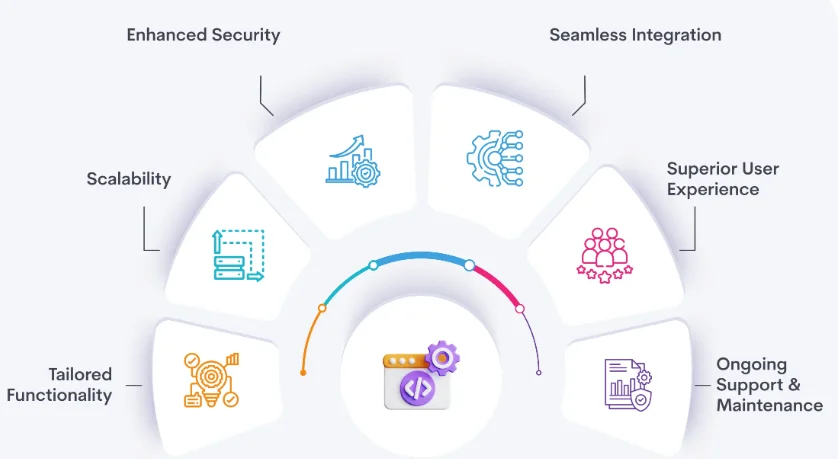
Buy a tool off the shelf and you inherit someone else’s idea of how the work should go. Most teams adjust without ever really deciding to; a step gets skipped here, a field gets used for something it wasn’t meant for there, and after a year the process belongs to the software rather than the other way round.
Custom development flips that. The workflow is the starting point, and the build follows it. That difference shows up fast once a team starts using something built specifically for how they work, rather than a tool they’ve had to work around for years.
2. Scale without rebuilding from scratch
Generic platforms often hit a wall right when growth accelerates, forcing a painful migration at the worst possible moment, usually mid-launch or right after a funding round closes.
A custom application, on the other hand, is built with scale in mind from day one. It grows alongside your business instead of forcing a rebuild every time user numbers jump past whatever limit the original platform was designed around.
- No sudden migration scramble. Architecture decisions made early account for growth, so a spike in traffic doesn’t mean an emergency rebuild.
- Costs scale predictably. Infrastructure grows in line with usage, rather than jumping in large unpredictable steps tied to a vendor’s pricing tiers.
3. Choose the right development partner sets the foundation
Every custom build lives or dies on the partner behind it, more than almost any other single decision in the whole process. Knowing what to ask before signing a contract, covered well in this post on questions to ask an app developer, separates teams that end up with a scalable asset from teams stuck maintaining someone else’s shortcuts for years after launch.
A partner who asks about long-term scaling plans before writing a single line of code tends to build architecture that holds up. One who jumps straight to wireframes without that conversation often leaves a business with a product that works fine today and buckles the moment real growth arrives.
Action tip: Ask a potential developer to walk through how they’ve handled scaling for a past client. What they built matters less than how they planned for what came after launch day.
4. Remove the licensing ceiling of off-the-shelf software
Per-seat pricing punishes growth directly. A business that doubles its team on an off-the-shelf platform often doubles its software costs too, sometimes worse depending on the tier structure and which features get locked behind a higher plan.
Custom applications sidestep that entirely, since the cost structure isn’t tied to someone else’s pricing tiers or arbitrary user-count thresholds.
Example: A logistics company running 12 dispatchers on a per-seat SaaS tool hits a licensing roadblock the moment it hires its 13th. It forces an upgrade to a pricing tier built for a completely different scale of operation. A custom dispatch tool circumvents that ceiling entirely.
5. Internal tools that capture what your team needs
Generic internal software systems tend to collect information without really understanding it, the same kind of limitation showing up in how traditional employee feedback tools often fall short of capturing genuine signals.
It is a pattern worth learning from even outside the HR context it originally describes. A rating scale or a one-size-fits-all form gathers something, but it rarely captures the specific useful detail a growing team needs to improve week over week.
Custom internal tools solve this by design. Since the software gets built around a specific team’s real processes, it captures the kind of nuanced and honest inputs that generic forms miss entirely.
That same principle scales well beyond employee feedback too. Any internal tool built specifically for how a team communicates tends to surface better information than a generic template ever could. This matters more and more as a company grows past the size where informal conversations cover every gap on their own.
6. Fund a custom build without derailing cash flow
Cost is usually the first objection to custom development, and it’s a fair one to raise before committing a real budget. Strategies for securing app funding show that a custom build doesn’t have to mean draining a business’ entire runway upfront in one lump payment.
- Phased development breaks a build into stages, each one delivering something usable before the next phase begins.
- Milestone-based funding ties payment to progress, which keeps both sides accountable and reduces the risk of a project stalling halfway through.
- Staged rollouts let a business test a core feature with real users before investing further, catching problems while they’re still cheap and quick to fix.
7. Stay visible as AI reshapes how customers search
Customers increasingly find businesses through AI-powered search rather than a traditional Google results page. This shift changes what “visibility” even means for a scaling business trying to keep up with where its audience looks first.
When you track that shift with a dedicated GEO platform like Similarweb, it gives your growing company real data on how often it shows up in AI-generated answers, alongside how it performs in traditional search rankings.
For a business investing in a custom web application, this pairs naturally with the build itself. A well-structured custom site tends to perform better in AI search results since clean architecture and clear content structure are precisely what AI models favor when deciding what to cite in an answer.
Businesses that build both pieces together, the application and the visibility strategy behind it, see faster payoff than those treating them as separate projects.
(Image credit: Neontri)
8. Integrate with the tools your business already runs on
Most growing businesses already run on a handful of tools: a CRM, a payment processor, an inventory system that’s been in place for years and won’t be replaced anytime soon.
Off-the-shelf software solutions often integrate with some of these and not others, thereby forcing manual workarounds that eat time every single day and slowly wear down a team’s patience.
Custom applications are built to connect with the stack a business already depends on, closing those gaps for good instead of patching them with another spreadsheet.
| Integration Need | Off-the-Shelf Software | Custom Web Application |
|---|---|---|
| CRM connection | Limited, plugin-dependent | Built to spec |
| Payment processors | Often restricted to a few options | Any processor a business chooses |
| Legacy systems | Rarely supported well | Fully integrated |
That table looks simple on paper, but the difference plays out in hours saved every single week once a team stops copying data between systems that were never designed to talk to each other.
9. Keep pace with digital transformation
Staying current with where technology is heading isn’t optional for a business trying to scale in a market that keeps shifting underneath it.
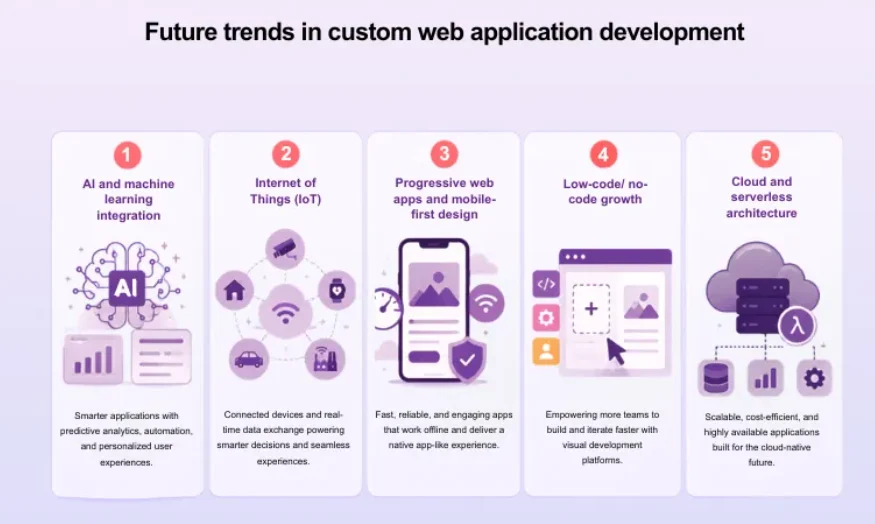
Knowing digital transformation trends can help you make decisions today that won’t need reversing in 18 months once the landscape moves again.
Custom applications adapt to these shifts far more easily than rigid pre-built platforms locked into one vendor’s roadmap and release schedule.
A business tied to a generic platform often waits months for a vendor to ship a feature it badly needs while watching competitors move faster in the meantime.
A custom app can add that same capability on its own timeline, driven by a business’ priorities rather than someone else’s product roadmap.
10. Mobile and web working as one growth engine
A business scaling today rarely gets to choose between mobile and web, since customers expect to move between both seamlessly.
Custom mobile app development built for real business growth shows how the two channels reinforce each other when they’re built to share the same backend and user data instead of running as two disconnected systems.
A customer switching from browser to phone shouldn’t notice a seam anywhere in the experience, whether they’re browsing a catalog on desktop at lunch or completing a purchase on their phone during a commute back home.
A unified custom build makes that seamless experience possible, and it’s the kind of consistency that generic platforms, cobbled together from separate mobile and web products, struggle to deliver.
(Image credit: Neontri)
Build the foundation that really scales
Custom web applications cost more upfront than generic alternatives, and that trade-off is worth being honest about from the start rather than glossing over in a sales pitch.
What that investment buys is software that grows with your business instead of forcing a rebuild every time the business outgrows what it started with. From workflow fit to AI visibility and mobile-web integration, every element above points toward the same idea: software built specifically for one business tends to scale a lot more gracefully than software built for everyone in general.
The businesses that scale the smoothest treat their software as a long-term asset from the very first conversation.
Editor’s note: This article is written by a guest author and provided for general informational purposes only. The views and opinions expressed are those of the author and do not necessarily reflect those of Appetiser Apps.
About the Author
Himaan Chatterji

Himaan Chatterji is a B2B SaaS content strategist and co-founder of Confiscore.com. When AFK, he is either latin dancing or cooking.

Maria Krisette Lim is a Content Marketing Specialist with 14 years of experience producing web and print ad content. Krisette has a BSBA degree, major in Business Management and Entrepreneurship. When she’s not tinkering with words and punctuation, she’s either curled up with a book while sipping hot tea, playing with her toddler, or tinkering with website builders.