The Product Management Process: 4 Easy and Digitally-Powered Steps



With dozens of ways to create or enhance a product, choosing the right method can be challenging.
The issue becomes more complex when you consider the fact that it can be difficult to choose the right product idea from a myriad of conflicting options.
But there’s a way out of the fog.
Read this article to learn about an effective product management process, distilled into four simple steps. Learn how to leverage your team, customers, and cutting-edge technology to develop new products or improve existing ones.
This guide can provide insights, whether you’re creating apps and other digital assets, or are more involved with traditional businesses.
Now that you know what’s in store, let’s begin by reviewing the basics of product management.
What is product management?
Product management is the process of bringing new products to market or improving existing ones. It encompasses a process that begins with ideation, where product managers generate and refine ideas, and progresses through development and evaluation stages to assess the idea’s success. Throughout, product managers consider factors such as customer/user experience, business goals, and technical feasibility.
Product management involves collaborating with top leadership, designers, product specialists, marketers, and customers. It starts with understanding the customer’s needs and how the product can address these pain points.
Through tasks, meetings, and decision-making frameworks, product management ensures smooth transitions through the product lifecycle—from strategy and development to launch and post-launch improvements.
The 4 Main Steps of an Effective Product Management Process
Creating or enhancing a product involves several strategic steps, especially in a world where 60% of customers online make purchases using their mobile phones.

Source: Statista
By leveraging nearly a decade of experience in developing apps for businesses and nonprofits, we’ve distilled an effective, digital-powered product management process to help you remain competitive for the long haul.
Here are the four main steps to guide you:
Step #1: Ideate on what new product or features you want to develop
When we at Appetiser Apps help our clients develop their app ideas, we ask them to conduct market research and competitor analysis first to guide the ideation process better.
We also recommend that you use your customers and rivals as sources of inspiration when developing a product vision or idea. If you do this, your new product or feature enhancements will have a better chance of achieving product-market fit. The more your product matches market needs, the more likely you will get a higher return on investment.
Equally crucial to creating the correct product idea is idea management.
As a product manager, you need to organize and manage dozens of product ideas coming from various members of your team and other stakeholders. Keep these ideas in one central place, often called a product backlog. It is vital to regularly review this backlog to help remove old or irrelevant ideas and keep the most feasible and impactful ones.
Transparency in the idea management process is also crucial. You must keep your stakeholders informed about the status of their ideas to foster strong and positive relationships within your product team and with your business partners.
Ultimately, getting inspiration from your rivals and customers while managing your product ideas will lead to concepts with a high chance of success. Keep a finalized list of your ideas for now, as you will use it later in the product management process.
Step #2: Outline your product strategy
An outline of your product strategy is crucial to speed up your product development or improvement efforts without sacrificing quality. Speed and quality in the product management processes often lead to a more cost-effective use of resources and greater customer or user satisfaction.
The three main tasks involved in outlining a product strategy are:
- Creating product specifications
- Roadmapping
- Feature prioritization
Creating product specifications
When outlining product specifications, it’s essential to detail the following:
- What is being built
- Why it’s needed
- How success will be measured
- The resources and effort required to develop or improve the product
Your product and project managers must ensure that these specifications are concise and developed collaboratively, with input from various team members. The more involved your product management team members are, the greater the clarity and consensus, leading to a more seamless workflow.
A well-written product specification can help you realistically plan your product roadmap.
Roadmapping
When creating a product roadmap, it’s crucial to plan around themes instead of features.
While feature-based roadmaps focus on detailing specific features and their launch schedules, they often miss the broader goals and user needs, potentially leading to features that neither solve core problems nor bring desired returns on investment.
In contrast, theme-based roadmaps emphasize high-level goals derived from user research, market trends, and business objectives. These roadmaps allow you to incorporate your findings from Step 1, such as customer or user sentiment and competitor characteristics.
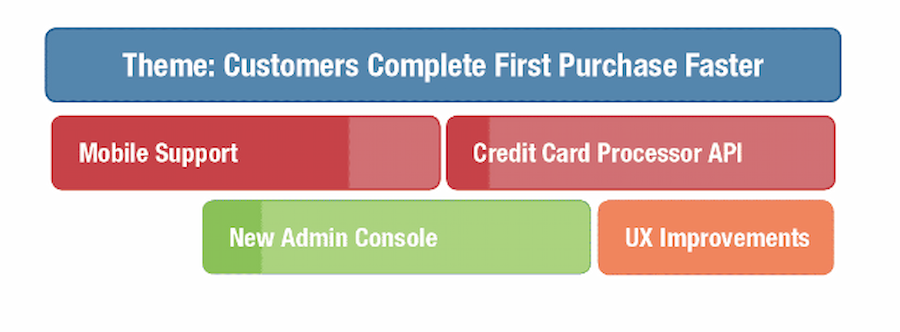
An example of a theme is “Speeding Up a Customer’s First Purchase.” Under this theme, you can put initiatives such as introducing UX improvements and a feature that enables users to pay using their credit cards.
Source: ProductPlan
As you can see here, theme-based roadmaps may still contain plans to introduce features (in this case, in-app gamification). But features are not the guiding stars of the product management process.
The theme-based approach to creating product roadmaps allows for flexibility, provides the much-needed “why” behind initiatives, and ensures a focus on delivering real value to users. The more real value you offer, the more likely your product management efforts will succeed.
Feature prioritization
After you’ve created your strategic goals in the roadmap, prioritize the product features you intend to build.
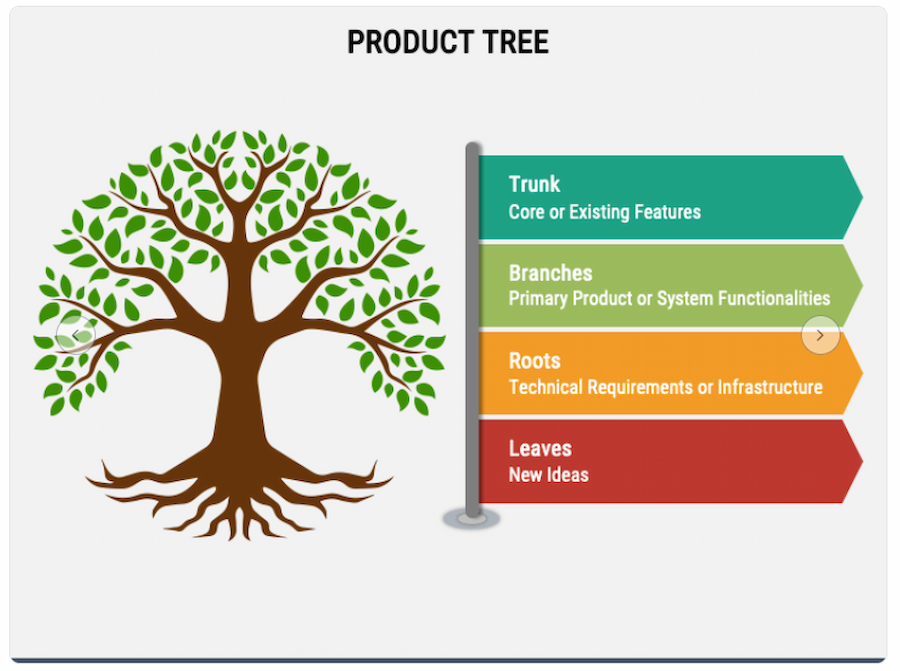
For this task, you can use frameworks like the Product Tree.
Source: SketchBubble
In this approach, the product is visualized as a tree: branches represent functionalities, the trunk signifies core features, leaves are ideas, and roots are the infrastructure. By “pruning” the tree, you can focus on the most valuable features.
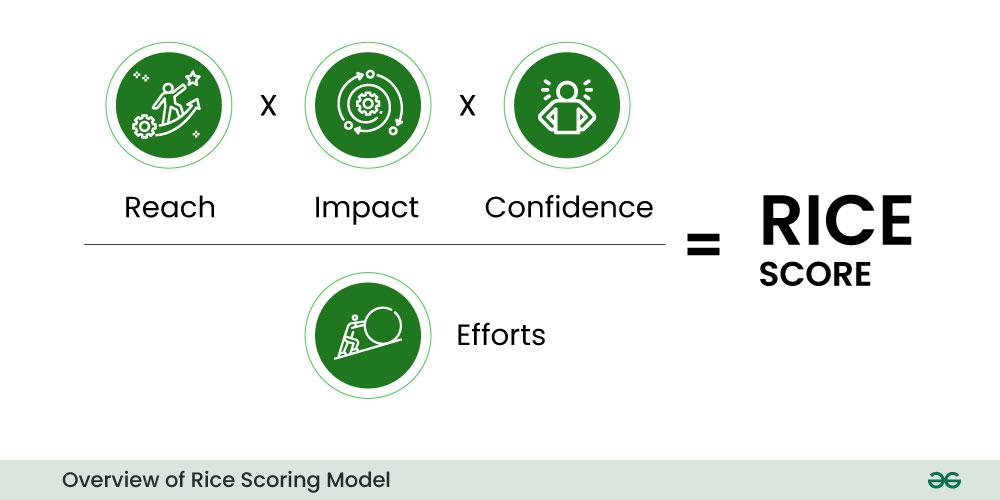
Another effective methodology is the RICE model. In this framework, you and your team will assign a score for each feature you are considering based on the following criteria: Reach, Impact, Confidence, and Effort. This structured approach helps in making informed prioritization decisions.
Ideally, you should go for the feature or features with the highest scores on Reach, Impact, and Confidence but with the lowest scores on Effort.
Here are some questions you can try answering to gauge how your product’s features measure up against the RICE model:
- Reach. How many potential customers can your feature serve?
- Impact. How does the feature improve your product or serve customers better?
- Confidence. How confident are you about your feature’s impact?
- Effort. How long will it take to develop your feature?
Source: GeeksforGeeks
For more information on the RICE model and other relevant frameworks, check out our article on how to prioritize features.
After creating product specifications, roadmapping, and feature prioritization, you are ready to begin the actual process of making your product idea a reality.
Step #3: Build and launch based on your outlined strategy
Once you have created a roadmap and prioritized features, you can start to develop your product or features.
The method of product building can vary widely across organizations.
In traditional waterfall models, detailed plans lead to infrequent releases of large chunks of features after extensive testing.
Agile methodologies break tasks into smaller, sprint-based cycles, allowing for more frequent improvements.
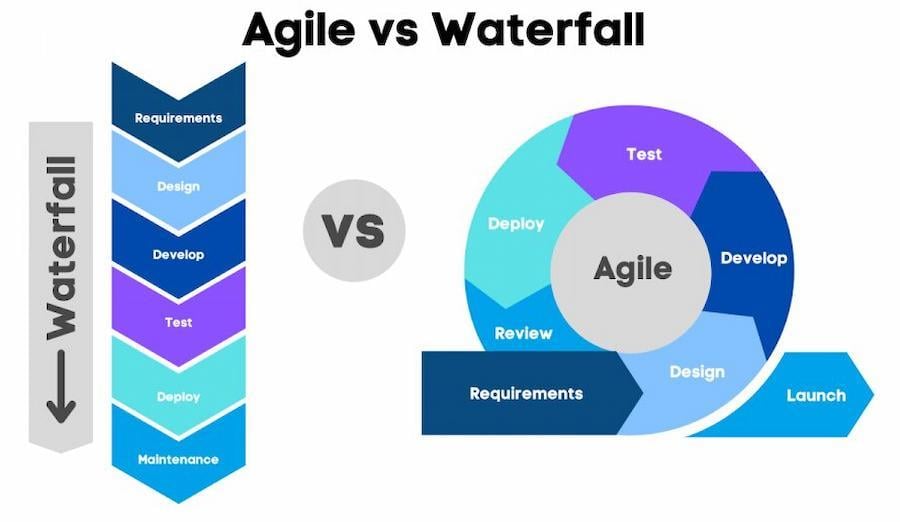
Source: Datavalley on LinkedIn
To better understand the Agile framework, imagine you tapped our expertise at Appetiser Apps so you can have a mobile app to expand your market reach or influence. In this scenario, this is how you can benefit from our Agile way of creating digital products:
- We will help you design and develop a minimum viable product (MVP), which is a high-quality, ready-to-launch app, but with just the core features. An MVP is better at validating product ideas and gaining market traction earlier than an app with all the bells and whistles.
- Your app’s feature requirements will be organized into Kanban monthly cycles under a clear product development roadmap.
- You will get access to a team tailored to the complexity of your app’s features and requirements. You can also collaborate closely with our product managers and developers throughout the app development process.
- Following the roadmap’s priorities, our development team implements your MVP design’s essential features according to the scheduled Kanban months.
- Our team will conduct regular meetings with you to check how your sample group of users responds to the app we developed.
- Depending on your users’ feedback and judgment of your app’s quality, you may choose to scale up, reduce, or pause development as needed without constraints.
- We will continue to enhance and develop your app based on user feedback if you choose to do so.
- Once you are satisfied with the quality of your app, we will help you launch it to your awaiting public.
If you’d like to know how our product strategist can help you realize your goals, schedule a free consultation with us.
Our Agile way of doing things is just one of many techniques you can use to develop your products or features. Whatever methodology you implement, effective product management ensures alignment with customer needs and your team’s expectations. This maximizes the chance your new product or features will gain market traction without sacrificing your company’s vision.
Step #4: Improve your product continuously
After launching your new product or features, remain alert for opportunities to enhance them. You can leverage the following to ensure your product remains competitive post-launch:
- Analytics tools
- Customer feedback
Analytics tools
To understand analytics tools, imagine your product as a brick-and-mortar grocery store. In this analogy, analytics tools are like cameras, microphones, and video recording systems that monitor your store’s customers.
When integrated with your product, analytics tools offer invaluable insights into customer data and behavior.
By analyzing this data, product managers can identify behaviors that improve the achievement of business goals, such as conversion rates or higher purchase frequency. The information in analytics tools helps you prioritize initiatives that could nudge users toward desired actions.
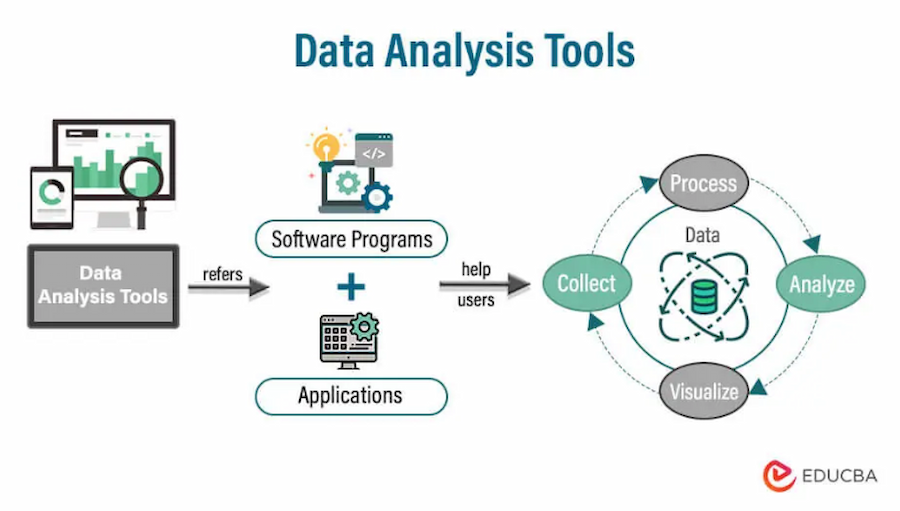
Source: EDUCBA
Analytics also guide product teams in identifying the traits and demographics of paying customers, enabling marketing teams to improve their ad targeting and other promotional strategies.
If you’re having trouble integrating analytics tools into your products, one of the best ways to overcome this issue is to design and develop mobile apps that suit your unique business needs. These types of apps offer powerful analytics tools that can help you monitor customer behavior and tailor your strategies accordingly.
A shining example of the power of mobile apps to empower a traditional business is Walgreens.
The U.S.-based pharmacy relied mostly on its brick-and-mortar branches to generate sales. But by 2008, the company digitalized its strategy by launching a mobile app. Without this app, Walgreens would have a harder time getting insights from customer behavior due to the absence of mobile app analytics tools.
Customer feedback
Another way you can discover insights into improving your product is through monitoring customer feedback.
You or your product manager must establish a robust process for capturing, organizing, and responding to this feedback, integrating it into the product development cycle.
As I mentioned earlier, gathering customer feedback would be easier if you had a mobile app integrated with your business. Other ways you can gain insights into your customers include talking to your customer service and sales teams, conducting interviews, and executing usability tests.
You can also leverage platforms like Listen360, a customer feedback management tool, to automate NPS surveys, centralize verbatim comments, and segment promoters/detractors. Feeding these insights into sprint reviews and your roadmap helps you prioritize fixes, validate features, and reduce churn.
Proactively seeking feedback, including insights from former customers, helps you precisely identify areas for improvement and ensures the product meets market expectations.
Your problems are your products
If I were to sum up product management in a single sentence, it is maximizing the use of human insights, industry information, and innovative technology to build or enhance products.
You don’t have to own a big company to see the relevance of product management. For instance, if you’re a middle manager in an insurance firm, is your office having difficulty processing claims? Are you second-guessing what your clients want from your firm?
Such problems and uncertainties are products in progress. They start the process by which you can start creating your own product, which you will eventually manage through the techniques you learned in this article.
Is there a problem you desperately want to solve for the people around you? Book a free consultation with us, and let’s find ways to turn your pain points into profitable products.
People also ask about the product management process
Now that you have a solid grasp of the four main steps, here are some of the most common questions we get from founders and business leaders when they start building out their own product management process.
1. What is the difference between product management and project management?
Product management is about deciding what to build and why—which problems to solve, which customers to serve, and how you will measure success across the product’s lifecycle. Project management is about the how and when: scheduling tasks, managing timelines, and making sure the team delivers what was defined.
Here is a simple way to picture it. Imagine your product manager decides your app needs a one-tap checkout feature because too many customers are abandoning their carts. Your project manager then maps out the development timeline, assigns engineers, and ensures that the feature ships on schedule.
2. What are the 5 C’s of product management?
The 5 C’s are a strategic framework product managers use to evaluate the environment around their product. They stand for Customers (who are they and what do they need?), Company (what are your business strengths and constraints?), Competitors (who else is solving this problem?), Collaborators (which partners or teams support your product?), and Context (what market trends or regulations affect you?).
Think of the 5 C’s as a checklist you run through during Step 1 of the process I described earlier. Before you commit resources to development, evaluating each “C” helps you pressure-test your product idea—much like how we ask our clients to conduct market research and competitor analysis before ideation begins.
3. What is the difference between the product management process and the product lifecycle?
The product lifecycle is the journey your product takes from the market’s point of view: introduction, growth, maturity, and eventually decline. It is like watching the seasons change for your product—you can observe where it stands, but the lifecycle itself does not tell you what to do next.
The product management process is your internal playbook. It is the series of steps—ideation, strategy, build, and continuous improvement—that you follow to guide your product through each of those lifecycle stages. In short, the lifecycle shows you where your product is; the process tells you what to do about it.
4. Can non-technical founders run an effective product management process?
Absolutely. You do not need to write code to lead this process. What you need is a clear understanding of the problem you are solving, a focused minimum viable product (MVP), and a repeatable way of validating ideas with real users.
Many of the founders we work with at Appetiser are not developers or engineers. They bring deep knowledge of their industry and the pain points their customers face every day. We then partner with them to handle the technical side—design, development, and testing—while they stay accountable for strategy, customer insight, and business outcomes.
5. Why do some product management processes have 7 stages instead of 4?
Different organizations break the process into different numbers of stages, depending on how detailed they want to get. A common seven-stage model lists idea management, specifications, roadmapping, prioritization, delivery, analytics, and feedback as separate steps.
I distilled the process into four steps in this guide because I believe clarity drives action. Whether you count four steps or seven stages, the core activities are the same. What matters is that your team follows a process they can actually repeat.
6. What tools do product managers use during the product management process?
Product managers typically rely on a mix of tools across each stage: roadmapping tools for planning, feedback platforms for capturing customer insights, collaboration tools for brainstorming with cross-functional teams, and analytics tools for tracking user behavior post-launch.
The specific tools matter less than how consistently your team uses them. As I mentioned in Step 4, integrating analytics tools—especially if you are building a mobile app—gives you the data you need to iterate effectively. The same principle applies to feedback tools: the earlier you centralize customer insights into your roadmap, the better your prioritization decisions will be.
7. How do you know if your product management process is actually working?
A working process produces a few observable outcomes. Your team ships improvements more consistently instead of scrambling between reactive fixes. There is less confusion about priorities—people know what they are building and why. And key metrics like conversion rates, user retention, or revenue are trending in the right direction over time.
If you find yourself constantly debating what to work on next, rebuilding features that missed the mark, or struggling to get alignment across your team, those are signs your process needs clearer stages, sharper decision criteria, and stronger feedback loops. The four steps in this guide are designed to give you exactly that structure.
Jesus Carmelo Arguelles, aka Mel, is a Content Marketing Specialist by profession. Though he holds a bachelor’s degree in business administration, he also took courses in fields like computer troubleshooting and data analytics. He also has a wealth of experience in content writing, marketing, education, and customer support.