How to Make an App and Build a Business Around It (2026 Guide)


Building an app in 2026 is surprisingly simple. You identify a problem, validate demand, build an MVP, launch it, and improve it based on feedback. The technology has never been more accessible. AI can generate screens. No-code tools can launch products in days. Developers are easier to access than ever.
Yet, most apps still fail for the same reason they always did: Nobody wanted them.
I’ve sat across the table from hundreds of founders with app ideas. Smart people. Motivated people. People who’ve already started sketching wireframes or have already paid an app developer.
And almost every time, I ask the same question: “Have you talked to anyone who’d actually use this?”
The silence that follows tells me everything.
So this isn’t a tutorial on how to make an app. It’s a guide to building the right app and avoiding the expensive mistakes I’ve watched founders make.
Step 1: Find a problem worth solving
One of the biggest mistakes first-time founders make is falling in love with an app idea before validating the problem, even though modern tools make it easier than ever to build your own app once the need is real.
People don’t download a mobile app because it’s innovative. They download apps because they solve a problem, save time, reduce stress, create convenience, or help them achieve something faster. Whether you want to create an app for a startup, a side project, or a business, that only matters if the problem is worth solving.
Before moving forward, ask yourself:
- What specific problem does this solve?
- Who in your target audience experiences this problem?
- How often does it happen?
- What are people currently doing instead?
If you can’t answer those questions clearly, you don’t have an app idea yet. You have a concept. And that’s fine. But treat it like one.
I’ve witnessed founders build great apps who have usually either lived the problem themselves or spent serious time with the people who have. There’s no shortcut for that.
The 3 Things Your App Idea Needs Before You Build Anything
I use these as a filter before recommending a single line of code for any app project:
1. Does it solve a real problem? People rarely adopt products simply because they’re interesting. They do because they improve something in their lives. Identifying and validating that core problem is a crucial step before wireframes or development begin, and before you try to build your own mobile app from an idea that is still only a concept.
2. Is there a market for it? A great solution still needs enough people who care about the problem. The goal isn’t to appeal to everyone. It’s to solve a painful problem for a specific audience. That focus matters especially for small businesses that can’t afford to build for everyone at once.
3. Can it make money? Not every app needs to become a unicorn. But every app business needs a path toward sustainability. Whether that’s subscriptions, transaction fees, advertising, licensing, or in-app purchases, there needs to be a viable business model behind the product. In many cases, subscriptions work best when users pay for premium features rather than basic access.
See related article: I Analyzed the App Monetization Strategies of Successful Brands: Here Are the 5 Models That Prove Effective
Step 2: Validate before you build
This is where I see money disappear. Founders move fast, which is good.
But they move fast toward building before they’ve confirmed anyone actually wants what they’re building. That’s the expensive part.
Real validation means talking to strangers who actually have the problem you’re solving. It means asking uncomfortable questions:
- How do you deal with this today?
- What’s annoying about your current solution?
- Have you ever paid for something that tried to fix this?
- Would you pay for something better?
You’re not fishing for compliments. You’re trying to find out whether a problem is painful enough that people will actually change their behavior and open their wallets.
App validation methods that actually work:
- Direct customer interviews (even 10–15 can be revelatory)
- Landing pages with a clear value proposition and email capture
- Waitlists with a simple sign-up (if nobody joins, nobody will download)
- Pre-orders or pilot partnerships
- Community building around the problem space
Not sure if your idea holds up? We’ll pressure-test it with you. No pitch. No obligation. Book a free consultation.
Step 3: Define your MVP
MVP stands for minimum viable product.
Unfortunately, many founders interpret this as: “Build everything I want, but cheaper.”
That’s not an MVP.
A true MVP focuses on solving one core problem exceptionally well. Even simple apps, the ones that do one thing really well, consistently outperform bloated products that try to do everything, and skipping validation often means wasting money on developers before demand is proven. Start with a clear user interface concept before expanding functionality.
Ask yourself: What’s the smallest version of this product that still delivers value?
Every feature should earn its place. Everything else can wait. Ruthlessly cut everything that isn’t core. Build the thing people actually need. Add everything else after you’ve proven they want it.
Step 4: Decide how you’ll build your app
There are now more ways to create apps than ever before, ranging from no-code tools to custom-coded products built from scratch.
The app development process you choose isn’t just a technical decision. It shapes your timeline, your testing process, your launch plan, and how much money you burn before you’ve proven anything.
Here are your options and how I actually think about them:
No-code tools
No-code platforms can speed up application development by giving you pre-built features instead of requiring traditional custom builds from day one.
But no-code tools have their place. If you’re purely testing an idea with zero budget, an app builder can get you moving fast and help you build fully functional apps without deep coding skills. That early choice shapes your entire mobile app development approach, while cross-platform development often relies on frameworks like React Native and Flutter.
You can customize a template to fit the first version. But most founders outgrow these tools quicker than they expect. Limited logic, restricted integrations, performance ceilings that show up the moment you get real users. What felt like a shortcut starts feeling like a ceiling.
AI-assisted development
This has genuinely changed the game in the last couple of years. No-code tools and AI-assisted platforms are now a realistic app builder option for founders without coding skills, helping with prototypes, generated user interfaces, and building apps far faster than was possible before. For early-stage founders who want to move fast and test assumptions, this is now a serious option.
These tools also let you customize templates and create fully functional apps quickly for early validation, including mobile-responsive versions that run in web browsers, but the caveat remains the same.
The caveat: complex products often outgrow AI-generated foundations, so be honest about what you’re building and plan for that technical debt conversation eventually.
Custom app development
Custom development means a real team building apps in modern environments like Android Studio for native Android apps, or using cross-platform frameworks such as react native to ship simultaneously to both the Apple App Store and Google Play Store.
You own the code. You control the roadmap. You’re not paying monthly fees to rent software that almost does what you need.
AI tools can also help teams produce fully functional apps and mobile-responsive web experiences that run in web browsers. For web-based MVPs, HTML and CSS are the foundation of the interface, while JavaScript is essential for interactive web app interfaces.
It costs more upfront. But founders who’ve rebuilt a no-code product from scratch will tell you: doing it right the first time is almost always cheaper than doing it twice.
Not sure which approach fits your stage? Let’s talk. We’ve had this conversation with hundreds of founders at this exact stage.
Step 5: Understand app development costs
Among the most common questions I get is “How much does it cost to build an app?” It’s also the most impossible to answer without context.
What I can tell you is this: cost scales dramatically with complexity, and the biggest financial mistake most founders make is spending on development before they’ve validated demand.
A few rough benchmarks:
| Build Approach | Estimated Cost | What to Expect |
|---|---|---|
| No-code platforms | $0–$500/month | Uses visual tools with pre-built components. Ideal for early-stage validation builds. |
| DIY / AI-assisted builds | $0–$5,000 | Built using templates, AI tools, or freelance support. Ideal for prototypes and scoped-down MVPs. |
| Basic app (professional builds) | $30,000–$60,000 | A functional app with core features to validate a market idea in real usage conditions. |
| Mid-complexity app (professional builds) | $60,000–$300,000+ | A product with broader functionality and custom design, typically built to support growing user and feature requirements. |
| Complex app (professional builds) | $300,000+ | A scalable system designed for performance, flexibility, and long-term growth. |
Sources: Cost ranges are indicative estimates based on industry benchmarks and market data from Business of Apps. Your actual cost will depend on scope, platform, team location, and complexity.
See related article: App Development Cost: Estimates and Smart Strategies
The number one thing that inflates app development costs without founders realizing it?
Building natively for both iOS and Android. That’s two separate builds, two separate teams, and roughly double the budget. For most early-stage products, cross-platform development — using frameworks like React Native or Flutter — gets you to both the Apple App Store and Google Play Store for significantly less.
The backend is the other one.
Most founders budget for the app and forget that databases, user authentication, and storage all have to be built and paid for too. Whether that’s Firebase, Supabase, or something like PostgreSQL depends on what your app actually needs. Each choice carries a different cost.
None of this needs to be figured out on day one. But knowing these decisions exist — and that each one has a cost attached — means you won’t be blindsided when a developer quotes you double what you expected.
The real framework: prove people want it first, then invest in building it properly. Getting those two steps backwards is how founders lose tens of thousands of dollars on apps nobody uses.
Not sure what your idea would cost to build? Get in touch. We’ll walk you through what actually moves the number.
Step 6: Choose how your app will make money
Monetization is not a post-launch problem. By the time you’ve built the product, it’s too late to discover your model doesn’t work.
App monetization models that work in 2026:
Subscriptions. Monthly or annual recurring revenue. Works best when users get ongoing, compounding value — think fitness apps, productivity tools, anything with fresh content or features. Subscriptions also give you predictable revenue and make your business more fundable.
Marketplace or transaction fees. You take a cut of transactions between two parties. Scales well but requires liquidity on both sides of the market, which is hard.
Advertising. Only really viable at significant user volume. Don’t plan your business around this unless you’ve already seen the growth numbers that make it viable.
In-app purchases. Works well for games and certain consumer apps. Can create strong revenue but requires careful design to feel fair rather than predatory.
Push notifications as a retention tool. Not a monetization model on its own, but one of the most powerful levers you have for keeping users engaged after download. Apps that use push notifications well — timely, relevant, not spammy — consistently outperform those that don’t on retention. Design your notification strategy before launch, not after.
The right model depends entirely on the value you’re creating. Think about it from the user’s perspective. When does this product deliver enough value that paying for it feels obvious?
See related Article: How Do Free Apps Make Money?
Step 7: Build your audience while you build your app
This is the most counterintuitive advice I give.
Most founders want to focus on building. I get it. But those who launch to crickets are usually the ones who treated finding users as something to figure out after the app was finished.
The founders who have launched mobile apps successfully? They’ve already been talking to their future users for months. They have a waitlist. They’ve built a small community. They’ve been sharing the problem they’re solving in the spaces where their target audience lives.
Ways to build pre-launch traction:
- Start a waitlist and promote it genuinely
- Create content about the problem your app solves (not your app itself)
- Build in communities where your target users already hang out
- Form pilot partnerships with early users who’ll give you real feedback
- Collect emails at every opportunity
Your first users shouldn’t discover you on launch day. They should be counting down to it.
See related article: Pre-Launch and Post-Launch App Marketing Guide
Step 8: Launch, learn, and iterate
Your first version won’t be perfect. That’s normal.
Every successful app — whether it’s a basic app earning its first hundred downloads from the Apple App Store, or a scaled platform doing millions of transactions — evolves through feedback, iteration, and continuous improvement.
The goal of launch isn’t perfection. The goal is learning.
- QA testing should confirm functionality across multiple devices and screen sizes — including both iOS apps and Android devices
- Watch how users actually behave, not how you expected them to
- Include integration, component, and user acceptance testing as part of every release cycle
- Identify friction points, improve the experience, repeat
As you iterate, you can publish updates to the Google Play Store and Apple App Store, refine weak points, and introduce new features based on real usage data.
The most successful app businesses are built through dozens — sometimes hundreds — of small improvements over time.
The Biggest Mistake New Founders Make
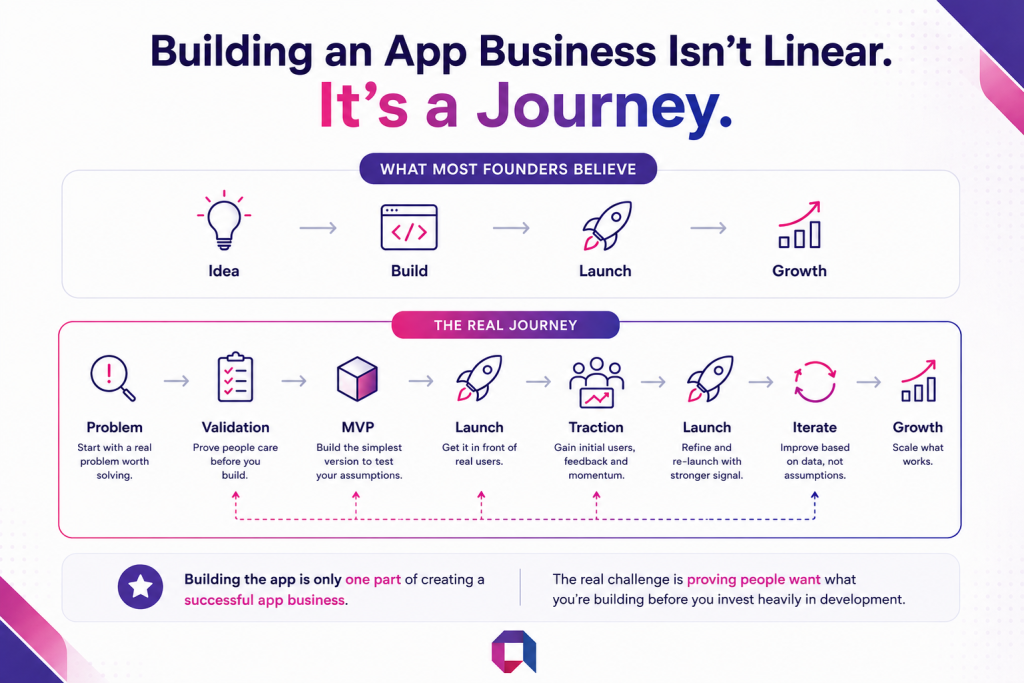
Most founders believe the journey looks like this:
Idea → Build → Launch → Growth
In reality, it looks more like this:
Problem → Validation → MVP → Traction → Build → Launch → Growth
Building the app is only one part of creating a successful app business. The real challenge is proving people want what you’re building before you invest heavily in development.
Ready to Build Something People Actually Want?
Most founders come to us after they’ve already made the expensive mistakes. The ones who come to us first? They move faster, spend less, and launch with confidence.
We help founders go from idea to validated, scalable app without the guesswork.
Book a free strategy call today. No pitch. No pressure. Just an honest conversation about whether your idea is ready to build.
People also ask
What is an app business?
An app business generates revenue by solving a real problem through a mobile or web application. Revenue usually comes from subscriptions, transaction fees, advertising, or in-app purchases. The keyword for a successful app business is “real problem.” The app is just the delivery mechanism.
How do you validate an app idea?
Talk to real potential users who actually experience the problem. Ask them how they solve it today, how much it frustrates them, and whether they’ve paid for solutions before. Use landing pages and waitlists to test interest. If you can’t get people to sign up for more information, you can’t get them to download your app.
How much does it cost to build an app?
Wildly variable. A simple no-code MVP can cost almost nothing to test; a custom-built, full-featured platform can run into six figures. The most expensive mistake isn’t spending a lot of money. It’s starting the app development process before you’ve validated demand.
Should I use no-code or custom development?
Use no-code to validate. Use custom development when demand is proven, and scalability genuinely requires it. Most founders jump to custom development too early.
How long does it take to build an app?
Simple MVPs: weeks. Complex apps with custom development: months. The timeline depends far more on scope clarity than on technical execution. Define your MVP tightly, and you’ll move faster than you think.
Do I need to build mobile apps separately for iOS and Android?
Not necessarily. Cross-platform frameworks let you build once and deploy to both the Apple App Store and Google Play Store, significantly reducing cost and development time. Native development — using something like Android Studio for Android apps — gives you more control and performance but requires platform-specific work. What’s right depends on your audience and product complexity.
How do apps make money?
The main models are subscriptions, transaction fees, advertising (requires significant volume), and in-app purchases. The right choice depends on what kind of value you’re delivering and when users feel it.
Maria Krisette Lim is a Content Marketing Specialist with 14 years of experience producing web and print ad content. Krisette has a BSBA degree, major in Business Management and Entrepreneurship. When she’s not tinkering with words and punctuation, she’s either curled up with a book while sipping hot tea, playing with her toddler, or tinkering with website builders.